


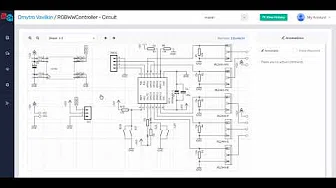




Files
README.mdView this project on CADLAB.io.

🔷 8051 Development Board with 16×2 LCD

A compact, modular embedded development platform built around the AT89S52-24AU, designed for rapid prototyping, firmware experimentation, and academic learning.

This board integrates essential support hardware such as regulated power, clock generation, reset management, USB communication, and a character display, enabling developers to focus on application development rather than wiring infrastructure.

✨ Highlights

✅ On-board +5V regulation
✅ Stable external crystal oscillator
✅ Power-on + manual reset
✅ Internal program memory configuration
✅ Port-0 external pull-up network
✅ USB ↔ UART interface
✅ 4-bit LCD communication
✅ Interview-ready schematic architecture
✅ Standard manufacturable footprints

🧠 System Block Diagram
        DC JACK / USB
              ↓
           REGULATOR
              ↓
             +5V
              ↓
        +-------------+
        |   AT89S52   |
        +-------------+
          ↓        ↓
        UART      LCD
          ↓
           PC

🖥 Display Interface

The board supports a WC1602A alphanumeric LCD operated in 4-bit mode.

This reduces pin usage while keeping full command/data capability.

Features:

Adjustable contrast via potentiometer

Dedicated enable & register select

Current-limited LED backlight

⚡ Power Architecture

External DC input

Linear regulation to 5V

Bulk + bypass filtering

Power indication LED

Designed for stable MCU and peripheral operation.

🔁 Communication

USB-to-serial bridge allows:

firmware debugging

terminal interaction

data logging

TX/RX cross routing follows standard UART design.

🧩 Hardware Design Philosophy

The schematic is organized into functional blocks:

Block   Purpose
Power   regulation & filtering
Clock   timing stability
Reset   reliable startup
Memory Config   internal execution
Port-0  logic integrity
UART    communication
LCD human interface

Net labels are used to avoid visual clutter and improve maintainability.

🛠 Tools & Workflow

Schematic capture and PCB layout in KiCad

Library-based footprint selection

ERC/DRC validation

Version control via GitHub / CADLab

🎯 Learning Outcomes

Through this project:

✔ understood microcontroller minimal system design
✔ practiced peripheral integration
✔ learned practical PCB planning
✔ implemented signal labeling strategy
✔ prepared hardware suitable for manufacturing

🚀 Possible Extensions

ISP programmer

GPIO expansion

sensor integration

wireless modules

RTOS experiments

📌 Status

✔ Schematic completed
✔ Footprints assigned
✔ PCB synchronized
✔ Ready for placement & routing